Hemp THC Ban Starts December 11, 2026: What Leaves the Shelf, What Stays, What Could Change It
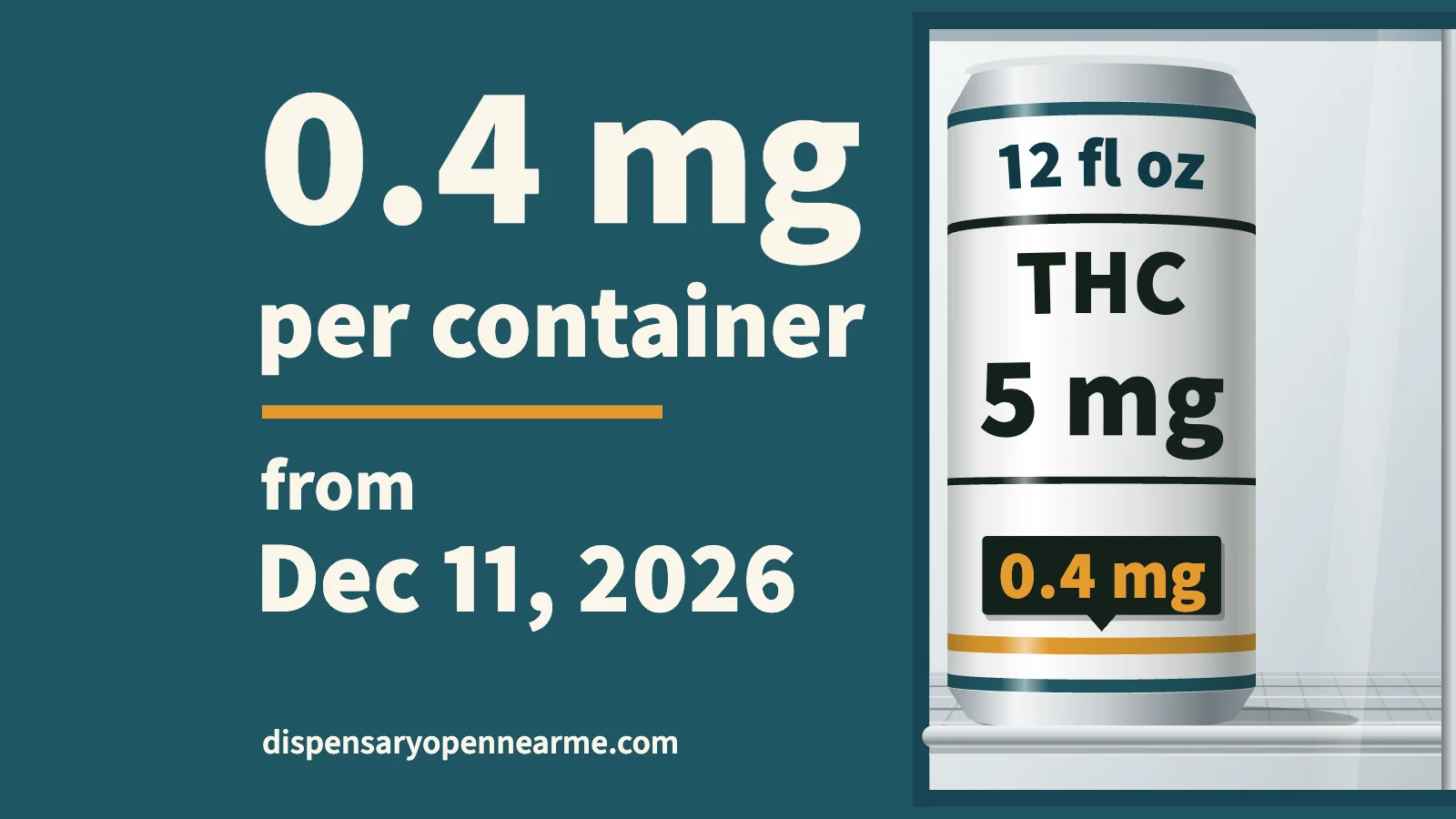
The hemp THC ban starts December 11, 2026, unless Congress acts: a product with over 0.4 mg of total THC per container, THCA included, stops being hemp; its text never mentions dispensary marijuana.
The hemp THC ban starts on December 11, 2026. From that day a finished hemp product with more than 0.4 mg of total THC in its container, THCA included, stops being hemp under Section 781 of the November 2025 funding law.
A 12-ounce THC seltzer labeled 5 mg holds 12.5 times that, by our arithmetic; a ten-count jar of 5 mg gummies, 125 times. Marijuana at a state-licensed dispensary is another matter: the text never mentions it.
Congress can still move the date. The stopgap funding in the September law that set it runs out the same day, so new funding is due by then, and the first delay rode in just such a law.
No new law had by November 24, 2026: not one of the 39 posted on govinfo.gov since September 2 mentions hemp, nor does any of the seven signed on November 20 (one ends penny minting) and November 23.
How December 11 got to be the day
Congress wrote Section 781 in November 2025 to start “365 days after the enactment,” on November 12, 2026. Then section 2019 of the Continuing Appropriations and Extensions Act, 2027, approved September 2, held back all but two clauses until December 11, both about cannabinoids the plant cannot make.
That is our reading of both laws, read November 24, 2026. The Congressional Research Service (CRS) agrees: the delay moved “most of the amendments.”
Every date, to scale:
The label, unrolled · to scale in days
Every date that set the hemp THC ban, from the law to December 11
Federal dates and five states’ own rules, each state’s marked with its name. The saffron line runs to Nov 24, 2026, the day we read the record.
Show all datesShow fewer
Section 781 becomes law (Pub. L. 119-37), set to start “365 days after”
The House passes H.R. 6500, the bill that later carries the delay
FDA’s four lists due, 90 days in (our count). None out by Oct 28, per CRS
The Senate passes it, amended, in August; the House agrees Sep 1; signed Sep 2 as Pub. L. 119-103, whose section 2019 delays most of Section 781
Only the exclusions for cannabinoids the plant cannot make apply
We read the record, 17 days before Dec 11. No law signed since Sep 2 mentions hemp (we searched through the seven signed Nov 20 and 23), and Congress could still move the date
California AB 8: no THC in hemp food and drink; no hemp flower or THC inhalables
Ohio Over 0.4 mg total THC per container is marijuana: only licensed dispensaries may sell it
Texas The state schedule covering delta-8 THC takes effect
Virginia Over 2 mg total THC per package is no longer hemp
Illinois Over 0.4 mg total THC per container is cannabis: only licensed dispensaries may sell it
The rest starts: 0.3% total THC with THCA, 0.4 mg per container, nothing made outside the plant, the intermediate-product rules. The stopgap funding in the same law ends
Where this comes fromHide where this comes from
November 12 took out one narrow class: products holding cannabinoids “not capable of being naturally produced by a Cannabis sativa L. plant.” The statute names no compound; CRS gives THC-O as its example. So “synthetic cannabinoids were banned on November 12” goes too far.
What changes on December 11: three tests
The hemp THC ban is a new definition of hemp, not a sentence that bans anything. To stay inside it a finished product must pass three tests in Section 781.
- Total THC, THCA counted. The 2018 test looked at delta-9 THC alone. The new one counts “total tetrahydrocannabinols concentration (including tetrahydrocannabinolic acid) of not more than 0.3 percent on a dry weight basis,” delta-8 and delta-10 included (CRS).
- 0.4 mg per container. A product is out at “greater than 0.4 milligrams combined total per container” of total THC and cannabinoids with similar effects. There is no per-serving figure.
- Nothing made outside the plant. Cannabinoids the plant can make that “were synthesized or manufactured outside the plant” put a product out at any amount.
A container is “the innermost wrapping, packaging, or vessel in direct contact with” the product, “such as a jar, bottle, bag, box, packet, can, carton, or cartridge.” Outer wraps the sale doesn’t need don’t count.
The text has no labeling rule and no penalty of its own. “To the extent” it takes effect, CRS says, “some additional products containing THC will be subject to control under the CSA,” the Controlled Substances Act.
That sorts everything four ways, from plant to cooler:
Family tree: from the plant to the shelfClose it
Family tree · from the plant to the cooler
What stays hemp after December 11, and what the new definition never touches
Each box is one part of the definition, and the rule under it says its fate. On a narrow screen the tree is printed generation by generation.
Follow one fate down the tree:
All four fates are shown. Press one to follow it.
Cannabis sativa L.
the plant, and everything made from it
Hemp
0.3% total THC or less, THCA counted, from Dec 11; delta-9 alone until then
Industrial hemp
fiber, grain, seed, microgreens, research: stays hemp
Untouched by Section 781
Hemp-derived cannabinoid products
anything with cannabinoids, from hemp other than industrial hemp, for inhaling, eating or the skin
Intermediate
powders and oils for mixing: out over 0.3% combined, and at any amount if sold to consumers as final
Out from Dec 11 if over the line
Final
out over 0.4 mg per container
Out from Dec 11 if over the line
Drink
can or bottle
Gummies
jar or packet; pieces wrapped one by one are an open question
Tincture
bottle
Vape
cartridge, named in the statute
Flower
jar: our reading, the statute never names flower
What is in them
sorted by where their cannabinoids came from
Made by the plant
delta-9 THC, THCA, delta-8 that occurs in the plant: all count toward total THC. CBD does not count toward the 0.4 mg, but full-spectrum CBD can carry THC (Iowa HHS)
Out from Dec 11 if over the line
Made outside the plant, from ones it can make
delta-8 converted from CBD, as CRS describes it
Out from Dec 11 at any amount
Ones the plant cannot make
THC-O in CRS’s example
Out since Nov 12
Marijuana
everything else, under the Controlled Substances Act: Schedule III for state-licensed medical marijuana since April 2026, Schedule I otherwise, per CRS
Untouched by Section 781
State-licensed dispensaries
sell under state law; Section 781 never mentions them
Untouched by Section 781
Show all generationsShow fewer
Where this comes fromHide where this comes from
What leaves the shelf: drinks, gummies, vapes, THCA flower
A drink, gummy or vape leaves if its whole container holds more than 0.4 mg of total THC. Our example labels miss that by a wide margin.
THC drinks and seltzers
The can or bottle is the container, so even a 2 mg can is five times the cap. On a 5 mg can the line sits barely a twelfth of the way up:
Turn the can · 3D
Where 0.4 mg sits on a 5 mg can: 8% of the way up
The saffron ring is printed at the federal line. Turn the can from its front to its back, or try the bigger can, whose front says the same.
This can, as labeled
- Size
- 12 fl oz (355 mL)
- Servings per container
- 1
- THC per serving
- 5 mg
- Total THC per container
- 5 mg
- The 0.4 mg line sits
- 8% of the way up
- Times the line
- 12.5 ×
A 12 fl oz can whose front says 5 mg THC per serving: 1 serving, so 5 mg in the can, 12.5 times the 0.4 mg line. The line sits 8% of the way up.
Where this comes fromHide where this comes from
Gummies and multipacks
For a jar of loose gummies the jar is the container. Pieces wrapped one by one are the open question: the statute counts the innermost wrapping, and FDA’s “additional information and specificity” on the term, due in February, was missing on October 28 (CRS). We found none by November 24.
Vapes
A cartridge is on the statute’s list of containers, so everything in it counts. Drop each product into one container:
The 0.4 mg line · drop it in
How far over the 0.4 mg line each product on a cooler shelf is
Press a product, or drag it into the container. The fill rises to its total THC: teal up to the line, hatched above it.
Jar of 10 gummies, 5 mg each
50 mg 125 × the line
Jar of 10 gummies, 5 mg each: 50 mg in the jar, 125 times the 0.4 mg line. Not hemp from December 11, 2026, as the law stood on November 24.
Show all productsShow fewer
Where this comes fromHide where this comes from
THCA flower
It fails on total THC alone. A gram labeled 20% THCA and 0.3% delta-9 (our example) passes the 2018 test, where only delta-9 counts. Under the new one it is 17.84% total THC with a 0.877 conversion factor or 20.3% as a plain sum, far above 0.3% either way.
Oregon’s agriculture department noted in November 2025 that “the federal bill does not yet specify how total THC must be calculated”; 0.877 is in its formula and in USDA’s rule for growers (7 CFR 990.1).
Check the label in your hand
Multiply the THC per serving by the servings, add every other kind of THC on the label, and compare the total with the law’s 0.4 mg:
Check your label · per container
Your label’s total THC per container, against the 0.4 mg line
Type the figures printed on the label. Nothing you type leaves this page.
Total THC per container
5 mg
- Times the 0.4 mg line
- 12.5
- THCA counted
- none on the label
Over the line
Total THC in this container: 5 mg, which is 12.5 times the 0.4 mg line. From December 11, 2026, as the law stood on November 24, a finished product over the line is not hemp under the federal definition.
- Not counted: cannabinoids with “similar effects” to THC, which the Secretary of Health and Human Services decides; FDA had published none of its promised lists as of October 28, 2026 (CRS).
- Stricter than the federal line: California, no THC in hemp food and drink (CDPH). The same line, sooner: Illinois since November 12, 2026 (IDOR) and Ohio since March 20, 2026 (Ohio DCC). Looser, so the federal line governs from December 11: Virginia 2 mg per package (VDACS) and Iowa 10 mg per container (Iowa HHS).
- This is arithmetic on the label’s own figures, not a lab result and not legal advice.
Where this comes fromHide where this comes from
What stays: the licensed shelf
Not by its text: Section 781 never mentions marijuana sold by state-licensed dispensaries. Under a state medical license that marijuana has been in Schedule III since April 2026, and “marijuana other than state-regulated medical marijuana remains in Schedule I,” CRS wrote in October. Section 781 changes neither.
No regulator we found says so outright. The nearest is Iowa’s: its “medical cannabis and consumable hemp programs operate under separate laws and requirements,” and products that stop being hemp cannot be sold through the medical program.
Industrial hemp stays too, grown for fiber, grain, seed or microgreens, and so does any product under the lines.
States with hemp THC rules of their own
We read seven states’ own pages on November 23 and 24, 2026. The federal change lands on top.
Each of the seven statesClose it
- Illinois did not wait: since November 12, 2026, a product over 0.4 mg per container is cannabis for licensed dispensaries only, and the Department of Revenue said it would enforce that “regardless of the federal government’s delay.” Hemp sold elsewhere can’t be meant for smoking or vaping.
- Ohio, since March 20, 2026: Senate Bill 56 bans intoxicating hemp products, and over 0.4 mg a product “is considered marijuana” for licensed dispensaries only (Division of Cannabis Control).
- Texas: delta-8 is a controlled substance, its Supreme Court confirmed, natural traces aside, under a schedule effective July 31, 2026; products labeled with it “may be detained and referred to law enforcement” (Department of State Health Services).
- California, since January 1, 2026 (AB 8): no THC or synthetics in hemp food, drinks or supplements, and no sale of hemp flower, pre-rolls or THC inhalables (Department of Public Health).
- Virginia, since August 15, 2026: “a product with more than two milligrams of total THC per package cannot be produced or sold as a hemp product” (agriculture department), five times the federal cap.
- Iowa: 4 mg of THC per serving and 10 mg per container, 25 times the federal cap.
- Tennessee: 1,301 licenses approved by July 2, 2026, products held to 0.3% total THC, THCA counted, among other limits, no THCP or synthetics (Alcoholic Beverage Commission).
Other states’ rules are not covered here; their regulators post them.
What to do before December 11
Start with the label you’re holding and the state you’re standing in, because those two decide what what changes for you.
- At a hemp shop. The federal law has no “general sell-through period,” Iowa’s regulator says. If the same 5 mg can is in the cooler on December 12, its label, not the shelf, tells you what it is.
- At home. Iowa warns that products no longer hemp “may become Schedule I controlled substances,” and that “Manufacturing, distributing, possessing, or selling these products may result in legal consequences.”
- At a dispensary. Confirm its license (here is how), bring an ID it accepts (which ones work) and check the tax (state by state). The federal change does not by itself move hemp products into a medical program; states decide for themselves.
- On the road, or online. the federal line is 0.4 mg in every state, “including online sales,” Iowa notes. Carrying marijuana across state lines is illegal under federal law, even between two legal states and with a medical card: under Schedule I or III, “unauthorized activities are subject to significant criminal penalties” (CRS).
What could still change it
It passed, and Congress has moved most of it once, by 29 days, in H.R. 6500. Watch for:
- The next funding law. Search it for “section 781”: the delay is one sentence headed “SECTION 781 EXTENSION” and never says hemp.
- Bills to postpone or repeal it. CRS lists three adding two years (H.R. 7024, H.R. 7010, S. 3686) and one repealing the change (H.R. 6209).
- Bills to redraw the line. S. 5736, introduced November 17, would raise 0.3% to 1% and drop the 0.4 mg cap; H.R. 10079 would exempt drinks meeting its own serving rules from that cap.
To check on any day, read each bill’s latest action on congress.gov (one chamber’s vote makes no law), the newest laws on govinfo.gov and your state regulator’s hemp page. Until a new law appears, December 11 stands.
Questions people ask
Does my CBD go too?
The 0.4 mg counts THC and THC-like cannabinoids, not CBD. Full-spectrum CBD carries some THC, though: Iowa’s regulator says some may exceed the limits, while CBD products “are not automatically prohibited.”
And delta-8?
It counts toward total THC from that day, and delta-8 made outside the plant is out at any amount. It “does naturally occur in hemp,” CRS notes, so November 12 missed it.
Can I buy THCA flower at a dispensary instead?
Yes, where sales are licensed: a dispensary’s flower, labeled by its THCA, is marijuana sold under the state’s license. The December 11 change reaches THCA flower sold as hemp.
So is hemp itself banned?
Not the plant. The change addresses what critics dubbed the “THC loophole,” CRS says: products under 0.3% delta-9 THC but over 0.3% total THC.
How this guide was made
Who wrote it, when it was checked, what changedClose it
- Written by
- Dispensary Open Near Me staff (who we are)
- Facts checked
- (how we check)
- How
- Researched and drafted with AI help from the records linked above, and checked against them (how we check). Corrections: our corrections page.
- Linked in the text
- 21 pages on 12 websites
- Published
- , updated
- Changes
- : Checked again on November 24, 2026: seven more laws were signed on November 20 and 23, none mentions hemp, and December 11 stands. Rewritten as a shorter news report.
- This site
- Independent: sells nothing and links to no store’s website.
- Found a mistake?
- Corrections · Editorial policy