Dispensary Purchase Limits by State, and How Flower, Vapes and Edibles Share the Same Ounce
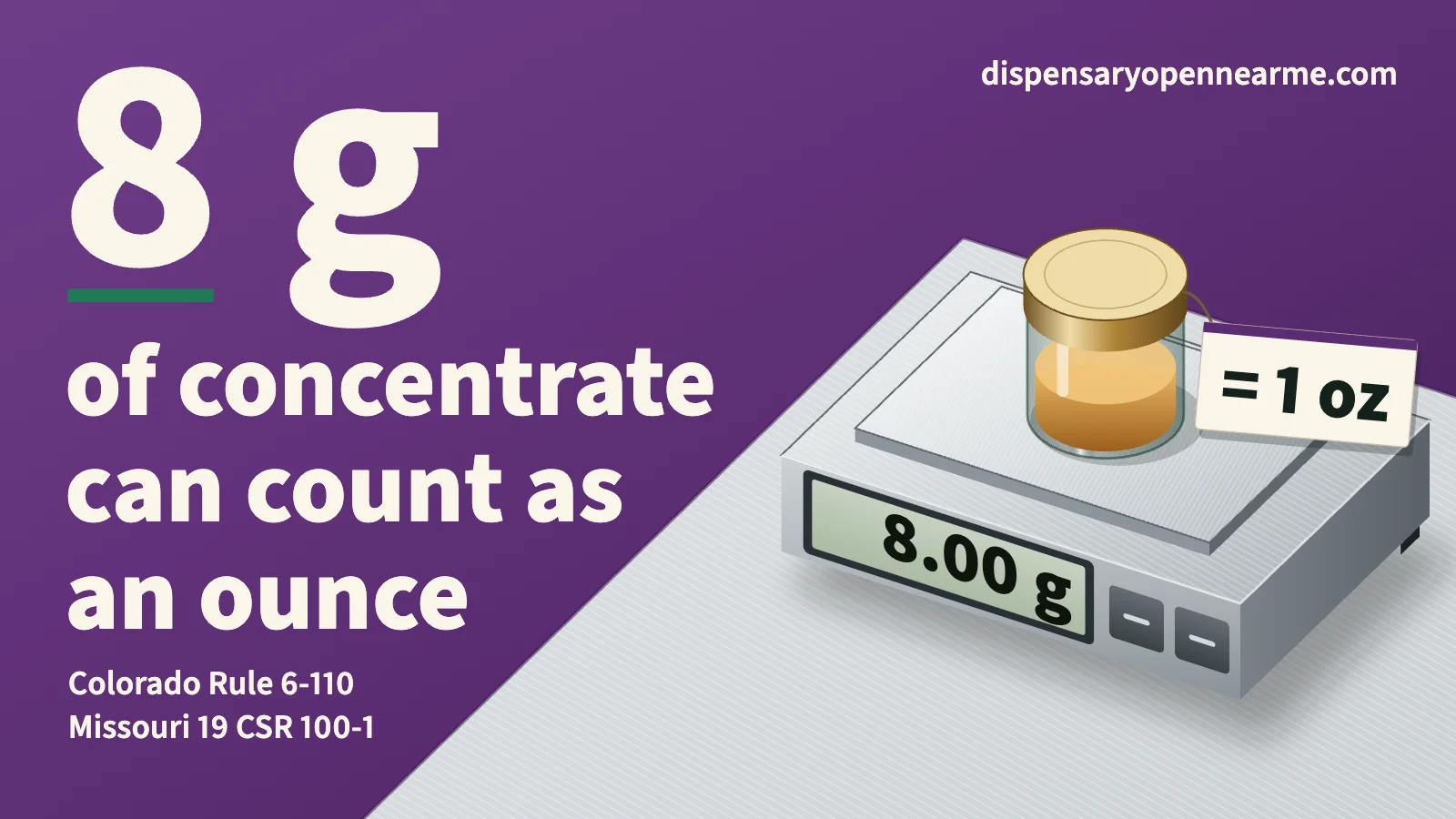
Dispensary purchase limits run from 1 to 3 ounces of flower by state, often shared: in Colorado and Missouri 8 g of concentrate or 800 mg of THC in edibles uses up a whole ounce.
Eight grams of concentrate, or 800 mg of THC in edibles, counts as a whole ounce under the dispensary purchase limits of Colorado, which stop at one ounce of flower at a time, and of Missouri, which stop at three (Colorado’s Rule 6-110 and Missouri’s 19 CSR 100-1, read November 24, 2026). No rule we read sets a lower or a higher flower figure than those two.
Behind the figures sit five kinds of rule. Six states trade other products against flower. Four put a smaller concentrate cap inside the one weight. Maryland lets one full kind shut out the rest, others cap each kind on its own, and a few never say. A visitor gets a resident’s limit in every rule we read but Illinois’s, which halves what a non-resident may hold.
Dispensary purchase limits by state, A to Z
One row a place: what a store may sell an adult 21 or older, or in Illinois what you may hold. All read November 24, 2026.
Lot 1 · the shelf labels What a store may sell an adult 21 or older, place by place
| Place | Flower | Concentrate | Edibles | Counted | How they share |
|---|---|---|---|---|---|
| Alaska | 1 oz | 7 g for inhalation | 5,600 mg of THC in everything | per day | each kind, under one THC ceiling |
| Arizona | 1 oz | 5 g of that | no figure | per transaction | concentrate inside the one weight |
| California | 28.5 g | 8 g, inside products too | the concentrate inside counts | per day | each kind on its own |
| Colorado | 1 oz | 8 g = 1 oz | 800 mg of THC = 1 oz | per transaction | one limit, everything added up |
| Connecticut | 1 oz | 5 g = 1 oz, by the 2021 act | 500 mg of THC = 1 oz, by the 2021 act | per day | added up, by the 2021 act |
| Delaware | 1 oz | 12 g | 750 mg of THC | per transaction | the rule doesn’t say |
| Illinois | 60 g, visitors 30 g | 10 g, visitors 5 g | 1,000 mg of THC, visitors 500 mg | possession limits | each kind on its own, to hold |
| Maine | 2.5 oz | 10 g of that | no figure | at one time or within one day | concentrate inside the one weight |
| Maryland | 1.5 oz | 12 g, vapes included | 750 mg of THC | per day | a full kind shuts out the rest |
| Massachusetts | 2 oz | 5 g of its THC = 1 oz | 500 mg of THC = 1 oz | per day and per transaction | one limit, everything added up |
| Michigan | 2.5 oz | 15 g of that | no figure | per transaction | concentrate inside the one weight |
| Minnesota | 2 oz | 8 g | 800 mg of THC | per transaction | each kind on its own |
| Missouri | 3 oz | 8 g = 1 oz | 800 mg of THC = 1 oz | per transaction | one limit, everything added up |
| Montana | 1 oz | 8 g of that | 800 mg of THC in solids, inside that | per transaction | concentrate inside the one weight |
| Nevada | 2.5 oz | 1/4 oz | 7,087 mg of THC, less beside flower | per transaction | flower trades against THC |
| New Jersey | 1 oz | 4 g = 1 oz | 1,000 mg of THC = 1 oz | per transaction | one limit, everything added up |
| New Mexico | 2 oz | 16 g | 800 mg of THC | at one time | each kind, and a total it doesn’t explain |
| New York | 3 oz | 24 g, with edibles and vapes | inside the 24 g | per day | the rule doesn’t say |
| Northern Mariana Islands | 1 oz | 5 g, cartridges included | 16 oz solid, 72 oz liquid | per transaction | each kind on its own |
| Ohio | 2.5 oz | by its THC | 15,000 mg of THC in all but flower | per day | each kind on its own |
| Oregon | 2 oz | 10 g, and 10 g to inhale | 16 oz solid, 72 fl oz liquid | at one time or within one day | each kind on its own |
| Rhode Island | 1 oz | 8.44 g = 1 oz | 84 servings of 10 mg = 1 oz | per day | one limit, everything added up |
| Vermont | 2 oz | 8 g in vape carts, the rest by THC | 8,400 mg of THC, with concentrate | per transaction | each kind on its own |
| Washington | 1 oz | 7 g | 16 oz solid, 72 oz liquid | per transaction | the rule doesn’t say |
| Washington, DC | No adult-use store. Registered patients, visitors included: 8 oz in a rolling 30 days (ABCA, medical cannabis patients). | ||||
Show all statesShow fewer
Where this comes fromHide where this comes from
Flower: 1 to 3 ounces at a time
One ounce is the most common answer, and a few states allow up to three:
- 1 ounce: Alaska, Arizona, Colorado, Connecticut, Delaware, Montana, New Jersey, the Northern Mariana Islands, Rhode Island and Washington. California allows 28.5 grams a day, a hair over the 28.35 grams in an ounce.
- 1.5 ounces: Maryland.
- 2 ounces: Massachusetts, Minnesota, New Mexico, Oregon and Vermont.
- 2.5 ounces: Maine, Michigan, Nevada and Ohio.
- 3 ounces: Missouri per transaction and New York per day (its delivery FAQ, March 2023).
Two are new. Vermont went from one ounce to two on July 1, 2026 (7 V.S.A. §907), says the Cannabis Control Board’s statement of July 17; its FAQ still quotes the old ounce. Massachusetts did the same in rules effective September 11, 2026 (935 CMR 500.140).
flower is the easy part. Concentrate is where the states spread out: the 8 grams that California and Minnesota allow is twice New Jersey’s 4-gram cap and a third of New York’s 24 grams.
Lot 2 · the bench scale Eight grams of concentrate, read by each state’s rule
In Colorado, 8 grams of concentrate is the whole one-ounce limit (Rule 6-110) and the statute’s 8 grams a day (C.R.S. 44-10-601, a copy).
The same 8 grams, state by state
Show all statesShow fewer
Under the state’s concentrate figure
- Missouri 1 oz of its 3 oz, 33%
- New York 33% of 24 g
- New Mexico 50% of 16 g
- Michigan 53% of the 15 g inside 2.5 oz
- Delaware 67% of 12 g, one of three alternatives
- Maryland 67% of 12 g; how other kinds add to a partial amount isn’t said
- Illinois resident 80% of 10 g, a possession limit
- Maine 80% of the 10 g inside 2.5 oz
- Oregon 80% of 10 g
- Rhode Island 95% of the ounce (8 ÷ 8.44)
At the figure exactly
- California 100% of 8 g; the flower cap untouched
- Colorado 100%: the whole ounce, and the statute’s 8 g a day
- Minnesota 100% of 8 g
- Montana 100% of the 8 g inside 1 oz
- Vermont 100% of 8 g if it is distillate in vape carts; other concentrate by its THC, against 8,400 mg
Over it: the sale stops
- Nevada 113% of 1/4 oz (7.09 g), over by 0.91 g
- Alaska 114% of 7 g for inhalation, over by 1 g
- Washington 114% of 7 g, over by 1 g
- Arizona 160% of the 5 g inside 1 oz, over by 3 g
- Illinois visitor 160% of 5 g, a possession limit, over by 3 g
- Northern Mariana Islands 160% of 5 g, over by 3 g
- New Jersey 200% of the ounce (8 ÷ 4)
Counted by THC, not grams
- Massachusetts by its THC: 5 g of THC counts as 1 oz of the 2 oz
- Ohio its THC counts against 15,000 mg a day
- Vermont outside vape carts its THC against 8,400 mg
No gram figure to read against
- Connecticut 5 g = 1 oz, by the 2021 act; not confirmed for today
- Washington, DC no adult-use store
Where this comes fromHide where this comes from
One shared ounce: how vapes, edibles and concentrate use it up
Nearly every rule we read limits concentrate and most limit edibles; what differs is how they’re counted. Turn the wheel for one kind of product, state by state.
Mind map: what shares the ounceClose it
Lot 3 · the wheel Eight kinds of product around one ounce of flower
1 oz of flower= 28.35 g
1 Concentrate
Equals the ounce at
- 4 g New Jersey
- 8 g Colorado, Missouri
- 8.44 g Rhode Island
- 5 g of THC Massachusetts
Capped on its own at
- 5 g inside the ounce Arizona
- 8 g inside the ounce Montana
- 5 g, in a cartridge or not Northern Mariana Islands
- 7 g Washington
- 7 g for inhalation Alaska
- 1/4 oz (7.09 g) Nevada
- 8 g California, Minnesota
- 10 g Oregon
- 10 g inside 2.5 oz Maine
- 10 g possession, 5 g for visitors Illinois
- 15 g inside 2.5 oz Michigan
- 16 g New Mexico
- 24 g New York
One of three maximums
2 Edibles
Equal the ounce at
- 500 mg of THC Massachusetts
- 800 mg of THC Colorado, Missouri
- 84 servings of 10 mg (840 mg, our arithmetic) Rhode Island
- 1,000 mg of THC New Jersey
Capped on their own at
- 800 mg Minnesota, New Mexico
- 800 mg inside the ounce, solid edibles Montana
- 1,000 mg possession, 500 mg for visitors Illinois
- 8,400 mg together with concentrates Vermont
- 15,000 mg with everything but flower Ohio
- 5,600 mg with everything, flower included Alaska
Traded against flower on a chart
- 7,087 mg with no flower, 4,255 mg beside 1 oz, none beside 2.5 oz Nevada
One of three maximums
- 750 mg, or 1.5 oz of flower, or 12 g: combined Maryland
- 750 mg, or 1 oz of leaf, or 12 g: whether they combine isn’t said Delaware
No milligram figure
- the store counts the concentrate inside California
- no conversion in the rule Michigan
- none named Arizona
3 Vape carts
Counted as
- concentrate, by weight Maryland
- 8 g of net distillate Vermont
- 10 g of products for inhalation Oregon
- part of the 8 g of concentrate California
- part of the 5 g of concentrate Northern Mariana Islands
- part of the 24 g of concentrated cannabis New York
- concentrate: 4 g of oil equals the ounce New Jersey
5 Tinctures and oils
Counted as
- concentrate, by the THC inside Massachusetts
- part of the 24 g of concentrated cannabis New York
6 Solids and liquids by weight
Capped by product weight
- 16 oz solid, 72 fl oz liquid Oregon
- 16 oz solid, 72 oz liquid Northern Mariana Islands
- 16 oz solid, 72 oz liquid, or 200 mg of THC in units of 4 mg or less Washington
7 Topicals
Left out of the limit
- exempt when not psychoactive Colorado
- not limited Massachusetts
- non-psychoactive topicals excepted Delaware
8 Seeds and plants
Counted apart
- up to 6 seeds on top of the ounce Colorado
- 6 immature plants a day California
- 4 immature plants and 10 seeds Oregon
- 10 seeds Northern Mariana Islands
- 6 immature plants New Mexico
Show all statesShow fewer
Where this comes fromHide where this comes from
One limit, counted in equivalents
In Colorado the whole basket has to fit inside one ounce, with 80 ten-milligram servings as its 800 mg (1 CCR 212-3, Rule 6-110). Missouri uses the same rate on three ounces, so its ceiling is 24 grams of concentrate or 2,400 mg of THC, by our arithmetic (19 CSR 100-1).
Massachusetts gives edibles less room, 500 mg of active THC to the ounce, and counts concentrate by the THC inside it: 5 grams of active THC equals the ounce, tinctures included (935 CMR 500.140). There the label decides, not the weight.
New Jersey’s commission puts the ounce at 4 grams of concentrate or 1,000 mg of THC, so half an ounce of flower and 2 grams of concentrate fill a sale (its consumer page). Rhode Island’s table puts it at 84 ten-milligram servings or 8.44 grams of concentrate (560-RICR-10-10-2).
Nevada prints its trade as a chart: with no flower you may buy 7,087 mg of THC in other products, with an ounce 4,255 mg, with the full 2.5 ounces none. Concentrate stops at a quarter ounce, about 7 grams; the chart doesn’t say whether it also counts there.
Put an ounce of flower on one pan and the balance finds what weighs the same on the the other.
Lot 4 · the equivalence balance What weighs the same as your flower, at each state’s own rate
The dial: a tick at a quarter, a half and a whole ounce of difference either way; the needle leans to the heavier pan, and the jade tick is level.
Flower on the left pan
On the right pan
In Colorado, an ounce of flower balances 4 grams of concentrate plus 400 mg of THC in edibles: 1.00 oz against 1.00 oz, level (our arithmetic from Rule 6-110).
Where this comes fromHide where this comes from
Maryland: max out one kind and the rest is off
Maryland’s three amounts look like separate caps, and they aren’t. The daily limit is 1.5 ounces of flower, pre-rolls included, or 12 grams of concentrate, or products with up to 750 mg of THC, and “an individual purchasing the MAXIMUM amount of any one product type MAY NOT purchase any additional product type(s)” (guidance updated September 4, 2026).
Its own example of a violation is 1.5 ounces of flower and a 1-gram vape cartridge. Vapes and infused pre-rolls are weighed as concentrate. How two half-filled kinds add up it doesn’t say, so ask the store.
Separate caps, and the rules that don’t say
Here each kind has its own ceiling, and filling one leaves the others open:
- California, per day: 28.5 grams of flower and 8 grams of concentrate, counting what’s inside edibles and vapes. No milligram cap for edibles.
- Minnesota, per transaction: 2 ounces of flower, 8 grams of concentrate and edibles with up to 800 mg of THC, lower-potency hemp edibles included.
- Vermont, per transaction: 2 ounces of flower, 8 grams of net distillate in vape carts, or 8,400 mg of net THC in edibles or concentrates. For now, “a mixed sale is permissible if the above limits are not exceeded in any one category.”
- Oregon, per day: 2 ounces of flower, 10 grams of concentrate and 10 grams of inhalable products, 16 ounces of solid product and 72 fluid ounces of liquid, by the commission’s FAQ and its 2024 poster; an older copy of the rule prints 5 grams for the first two.
- Ohio, per day: 2.5 ounces of flower (“dried cannabis plant material for vaporization”) and 15,000 mg of THC in everything else, though the guidance lets a store sell less. A 15-gram extract cap in the statute is reported, not confirmed.
- Alaska, per day: 1 ounce of flower and 7 grams of concentrate for inhalation, under a ceiling of 5,600 mg of THC for everything combined.
- New Mexico, at one time: 2 ounces of flower, 16 grams of concentrate and 800 mg of edibles, “or total cumulative amount,” words its FAQ doesn’t explain.
- Northern Mariana Islands, per transaction: 1 ounce of flower, 5 grams of concentrate (cartridges included), 16 ounces of solid product and 72 of liquid.
Four states put a smaller concentrate cap inside one total: 2.5 ounces with 10 grams in Maine, 2.5 ounces with 15 grams in Michigan, 1 ounce with 5 grams under Arizona’s voter-passed law and 1 ounce with 8 grams under Montana’s statute, whose limit covers “purchasing.” Montana also caps solid edibles at 800 mg of THC inside the ounce, and its Department of Revenue caps the THC in each package, not how many you buy; the other three name no edible figure.
Where the rule doesn’t say
Washington allows “any combination of” 1 ounce of flower, 16 ounces of solid product, 72 of liquid and 7 grams of concentrate in a sale without saying how a combination counts (RCW 69.50.360, WAC 314-55-095). Delaware’s has almost Maryland’s shape, 1 ounce of leaf, 12 grams of concentrate or products with 750 mg of THC, but nothing we read says whether the three combine (4 Del. C. §1332, 16 Del. C. §4701). New York’s FAQ counts oils, tinctures, edibles and vapes as concentrate and is silent on mixed baskets; Connecticut’s 2021 act counts 5 grams of concentrate, or 500 mg of THC in other products, as an ounce and adds a mix up (Public Act 21-1, section 3); today’s section wouldn’t open, so no piece here counts by it.
Your basket, through your state’s rule
How much weed you can buy at a dispensary shows only when the whole basket is counted. Pick your state, add what you’d carry to the register, and the checker marks the item where the sale stops.
Lot 5 · the basket checker Your basket, counted by your state’s own rule
Add from the bench (example sizes)
Flower or its equivalent, per transaction
1.12 of 1 oz · 112%
Concentrate in a day (statute)
2 of 8 g · 25%
Colorado, resident: 1.12 oz of flower equivalent, over the 1 oz limit. The sale stops at item 6, the third edible pack (100 mg THC, 10 × 10 mg). Up to item 5 the basket is 99.4% of the ounce.
Rule: 1 CCR 212-3, Rule 6-110, read November 24, 2026 · per transaction (same-business-day sales to one person count as one transaction when the store knows or should know they pass 1 oz) · one limit by equivalency: everything is turned into flower and added up. Concentrate in a day (statute): C.R.S. 44-10-601 (a copy).
Show all itemsShow fewer
- 1Half ounce of flower, 14 g (example)0.494 oz
- 2Concentrate, 1 g (example)0.619 oz
- 3Concentrate, 1 g (example)0.744 oz
- 4Edible pack, 100 mg THC, 10 × 10 mg (example)0.869 oz
- 5Edible pack, 100 mg THC, 10 × 10 mg (example)0.994 oz
- 6Edible pack, 100 mg THC, 10 × 10 mg (example)1.119 ozStop
Where this comes fromHide where this comes from
By hand, count in the rule’s own units. In Colorado an eighth of flower (3.5 grams), a gram of concentrate and a 100 mg pack of edibles are each about an eighth of the ounce, so eight such items fill it. In Massachusetts the same pack is a fifth of an ounce. For delivery plan on the same figures: New York prints its daily limit in a delivery FAQ, and Missouri’s covers what a store may “sell, deliver, or distribute.”
If the register says no
The clerk isn’t being difficult: most of these rules are written as what a store may not sell, and New York lets a store stop sooner than the state does. Ask which cap you hit and swap the item that tipped it. In a separate-caps state trading a cartridge for flower may be all it takes. In California and Ohio the count isn’t printed on the package: California’s rule makes the retailer work out the concentrate inside every edible and vape, and Ohio’s guidance has it read each product’s THC from its tracking record.
A medical card doesn’t add a second basket. California’s rule says the two limits “shall not be combined,” and Missouri’s says the same of patient and consumer purchases. All of this binds licensed stores; how to tell if a dispensary is legal takes a minute.
A day or a transaction: whether a second trip counts
Where the rule counts by the day, a second trip adds nothing. Where it counts by the transaction, some states still add up same-day sales:
- Per day: Alaska, California, Connecticut, Maine (“at any one time or within one day”), Maryland, New York, Ohio, Oregon and Rhode Island.
- Per transaction: Arizona, Colorado, Delaware, Michigan, Minnesota, Missouri, Montana (“at any one (1) time”), Nevada, New Jersey, Vermont, Washington and the Northern Mariana Islands.
- Both: Massachusetts (two ounces on each count).
- At one time: New Mexico. Illinois sets possession limits only.
Colorado counts same-day sales to the same customer as one when the store knows, or should know, they’d pass an ounce, and its statute adds a daily cap of 8 grams of concentrate (C.R.S. 44-10-601, a copy). New Jersey’s stores must make a good-faith effort to stop split purchases, and Missouri’s must report a customer whose several tries in one day would pass three ounces. Connecticut told stores that its ounce a day, since July 30, 2025, holds “regardless of the number of transactions a consumer makes.”
Non-residents: a resident’s limit, except in Illinois
Everywhere else the rules speak of a person, a consumer or an adult 21 or older, so Michigan’s 2.5 ounces and Missouri’s 3 apply to visitors as written. Some tables online give Colorado visitors a quarter ounce; its current statute and rule have no visitor figure.
Washington, DC, has no adult-use stores, but it registers non-residents as medical patients, who may buy up to 8 ounces in a rolling 30 days (ABCA). Wherever you buy, it stays there: “Leaving or coming into the state or country with any cannabis product is against the law,” New York’s cannabis office says. Which IDs a store may take is in our guide to dispensary ID requirements.
Chart: every state’s limits on one scaleClose it
Lot 6 · the flower limits Flower a resident and a visitor may buy, state by state, in grams
Where this comes fromHide where this comes from
How much can you buy at a dispensary in Illinois?
As much as you may hold, as we read it, since the only figures are possession limits: 60 grams of flower, 1,000 mg of THC in infused products and 10 grams of concentrate for a resident, and half of each for a visitor, under SB 3222 (Public Act 104-0463), signed and in effect June 12, 2026 (IDFPR’s fact sheet). We found no per-sale cap. The totals are cumulative, so you may hold some of each kind up to its own limit, says the state’s cannabis FAQ, which still carries an older paragraph with 30 grams, 500 mg and 5 grams for residents; the fact sheet is the later document.
Medical limits run on their own clock
- A day: California 8 ounces, or the physician’s amount; Oregon (a copy) 8 ounces, and 32 in a calendar month; Michigan 2.5 ounces, and 10 a month; Montana 1 ounce, and 5 a month unless the state allows a patient more; Colorado, in a business day, 2 ounces of flower, 8 grams of concentrate (2 at ages 18 to 20) or products with 20,000 mg, alone or mixed, unless a doctor has put down more (Rule 5-125). Ohio’s day is 2.5 ounces, and a patient may buy four days’ at once: 10 ounces and 60,000 mg of THC.
- About two weeks: Illinois (a copy) 2.5 ounces in 14 days; Delaware 3 ounces, and 6 a month; Massachusetts 2.5 ounces, or 10 in 60 days; Rhode Island 2.5 ounces or its equivalent in 15 days; Maine’s visiting patients 2.5 ounces in 15 days.
- A month: Connecticut 5 ounces, unless the practitioner sets another amount; in any 30 days, Missouri 6 ounces unless certified for more, New Jersey 3 and Maryland a 30-day supply, in portions, within the patient’s certification.
- Two months: New York a 60-day supply, or 3 ounces of flower and 24 grams of concentrate, whichever is greater, within the provider’s recommendation.
- Three months: New Mexico 425 units, about 15 ounces; a unit is a gram of flower or 200 mg of THC.
- No period given: Washington 3 ounces of flower, 21 grams of concentrate or infused products by weight, at a medically endorsed store; Arizona’s allowable amount, 2.5 ounces; Nevada the same as any buyer; Vermont no more in a sale than a patient may possess. Alaska has no patients’ limit of its own, and Minnesota sets no amount.
Medical-only places, for their own patients
Each medical-only place’s limitClose it
- About two weeks: Arkansas 2.5 ounces in 14 days, South Dakota 3 ounces in 14, Hawaii (a copy) 4 ounces in 15 and 8 in 30.
- About a month: Florida 2.5 ounces of smokable flower in 35 days, inside a 70-day supply in any 70; Kentucky a 30-day supply in any 25 days (112 grams of flower, 28 of concentrate or 3,900 mg of THC); Mississippi 24 units in 30 days and 6 in a week, a unit being 3.5 grams of flower or, since July 2025, 1 gram of THC in a product; North Dakota 2.5 ounces of flower and 6,000 mg of THC in products in 30 days; Utah 113 grams of flower and 20 grams of THC in other products in 28; Virginia 4 ounces of flower for each 30 days of a 90-day supply; West Virginia 6 ounces or 60 grams of concentrate in 30.
- Counted otherwise: Puerto Rico an ounce a day; Oklahoma 3 ounces a sale; Alabama 60 daily doses in 60 days; Iowa 4.5 grams of THC in 90 days; Pennsylvania a 90-day supply, 192 units, within the certification; Texas a 90-day supply at the dose prescribed; Georgia as much as keeps a patient at 12,000 mg of THC.
A practitioner can set more in several of them, and each place’s row says where. Louisiana’s and New Hampshire’s rules wouldn’t open for us.
California, Michigan, Ohio and New Jersey in a line each
- California: 28.5 grams of flower and 8 grams of concentrate a day, plus 6 immature plants. The concentrate inside edibles and vapes counts.
- Michigan: 2.5 ounces per transaction, no more than 15 grams of it concentrate, with no daily figure in the rule.
- Ohio: 2.5 ounces of flower a day plus products holding up to 15,000 mg of THC, under the state’s guidance of May 2025.
- New Jersey: one ounce of flower or its equivalent per transaction: 4 grams of concentrate or 1,000 mg of THC in edibles is the whole ounce, and a mix adds up.
Whatever the figure, it’s for use where you stand: Colorado’s rule, for one, bars stores from delivering outside the state (Rule 6-110).
How this guide was made
Who wrote it, when it was checked, what changedClose it
- Written by
- Dispensary Open Near Me staff (who we are)
- Facts checked
- (how we check)
- How
- Researched and drafted with AI help from the sources linked above, and checked against them (how we check). Corrections: our corrections page.
- Linked in the text
- 71 pages on 51 websites
- Published
- , updated
- Changes
- : Every place’s limits now stand in one table, A to Z, and the basket checker sits at the middle of the guide. Nevada’s exchange chart is read, the Northern Mariana Islands are added, Montana, Arizona and Washington count by the transaction, Maine by the day as well, and Connecticut’s 2021 table is printed. Patients’ limits are corrected for New Mexico (425 units in any three months, not 15 ounces a month) and added for Connecticut, Delaware, New Jersey, Ohio, Washington, Maine’s visitors and 17 medical-only places.
- This site
- Independent: sells nothing and links to no store’s website.
- Found a mistake?
- Corrections · Editorial policy