Why Dispensaries Are Cash Only, and What a Cashless ATM at the Counter Does With Your Card
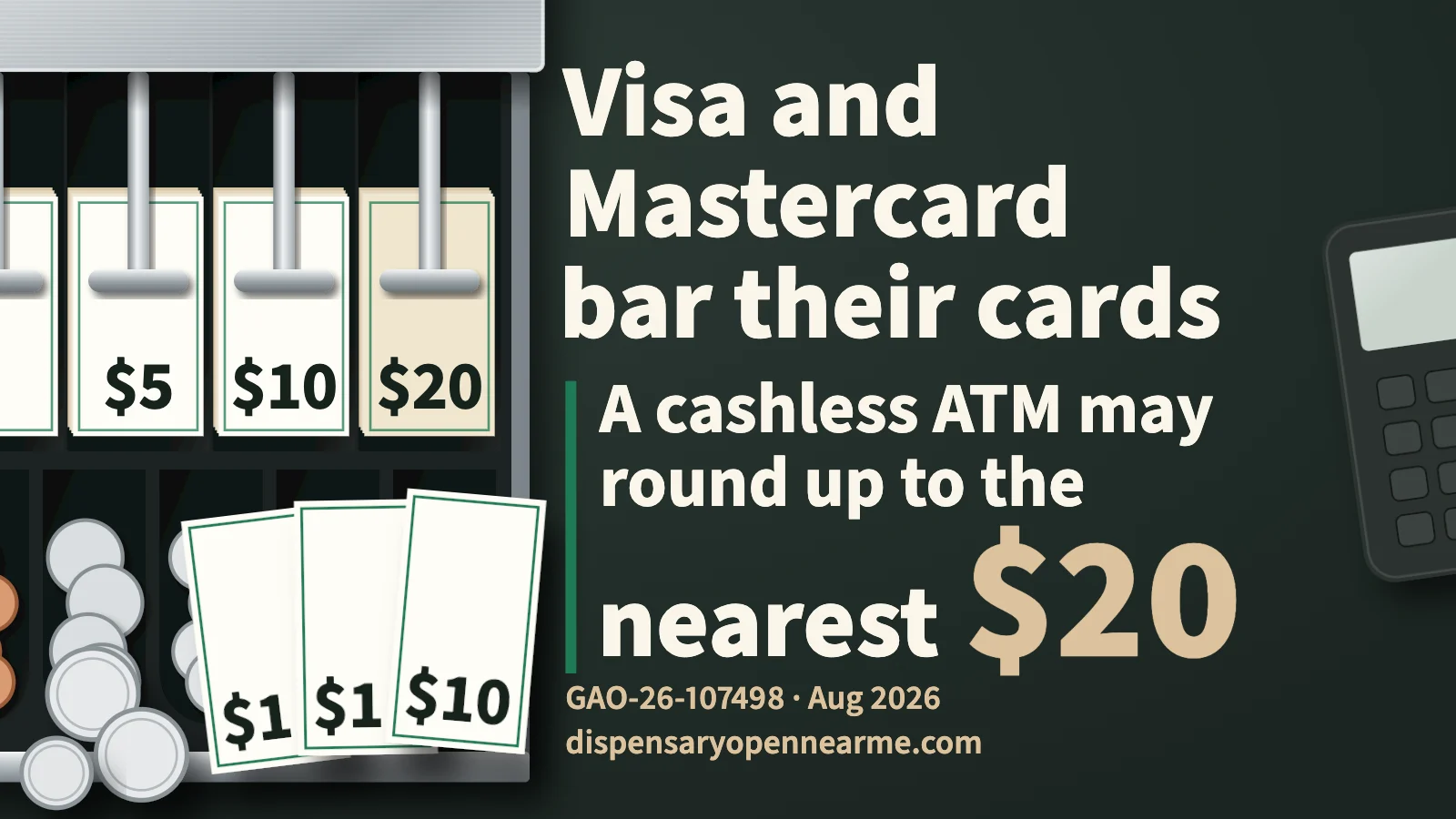
Visa and Mastercard bar their cards for cannabis, which is why dispensaries are cash only or work around it: a cashless ATM may round your debit charge up to the nearest $20 and hand back the change.
One $67.40 payment (our example) shows why dispensaries are cash only: by Visa or Mastercard it should stop at the terminal, because both networks “prohibit the use of their cards for cannabis-related transactions,” the U.S. Government Accountability Office (GAO) reported in August 2026 (GAO-26-107498).
Not every store stops at cash. Some send the $67.40 on a detour: through an ATM in the corner, a “cashless ATM” at the register, or an app that moves it from bank to bank. Each can take a fee on the way, and one can charge your card $80.00.
At the door with only cards, look for an ATM and ask what debit costs before anything is swiped. Don’t count on the machine: representatives of four organizations told GAO that cashless ATMs and other electronic payment methods “can be unreliable and frequently stop working without warning.” Cash is the one way to pay that no network can switch off.
At the terminal: why dispensaries are cash only
Behind the refusal is federal law. By July 2026, GAO counted, 24 states and the District of Columbia had legalized cannabis for adult and medical use and 15 more for medical use only, yet possessing, making or distributing it “remains illegal under federal law.”
Visa’s public rulebook (the October 24, 2026 edition, read November 24, 2026) never says cannabis. It doesn’t need to: it bars the banks that sign up merchants from knowingly accepting “any Transaction that is illegal” and has cardholder agreements rule out any unlawful purpose (Visa Core Rules, 1.5.1.4 and 1.4.3.1). As we read it, a state legalizing doesn’t move that ban. An organization representing the networks told GAO they won’t change their policies “unless cannabis is legalized at the federal level.”
American Express’s own rules bar its card in the U.S. at any business that “dispenses marijuana,” licensed or not (Merchant Rules, October 2026). We read no Discover rule; ask first. Mastercard’s rules wouldn’t open for us, and reports of a 2021–22 Visa warning about cashless ATMs and a 2023 Mastercard notice on debit couldn’t be confirmed on the companies’ own pages.
It isn’t your state. In a partial search of the 23 adult-use states’ store rules (Maine’s statute only), we found none that caps a shopper’s cash at the counter or bans or requires an in-store ATM.
Some stores try the card anyway, ringing up something else and handing over the cannabis as a “gift,” a trade group that represents both networks told GAO. Card companies that catch one may ban the business, a cannabis banking association’s representative said.
Take the credit card away and three kinds of money are left at the counter: cash, the debit networks, and bank transfers. Debit gets through only where it meets cash, at an ATM.
Mind mapThree kinds of money at the counter, once credit cards are out
1Cash only
Bills you bring. Adds nothing at the counter.
2Debit networks only
A Visa or Mastercard debit card run as a purchase: prohibited, like credit (GAO).
A phone wallet carrying that card: same rule, by our reading.
3Pay by bank only
An app moving money over ACH: several steps to link your account (GAO).
Washington: a convenience fee you may cancel (WAC 314-55-117).
Colorado: a store may take payment online for an order you collect in the store (HB23-1279).
4Cash and debit networks
In-store ATM: your card becomes cash.
Cashless ATM: looks like a withdrawal; may round up to the nearest $20, change in cash; may violate network rules (GAO).
5Debit networks and pay by bank
No way of paying we found uses a debit network and a bank app together.
6Cash and pay by bank
No way of paying we found turns a bank-app transfer into cash at the counter.
7All three
Every route that works draws on it, and your own bank’s fee schedule is the one list of fees you can read before you go.
8Outside all three
Credit cards: outside all three. Visa and Mastercard prohibit their cards for cannabis (GAO).
Where this comes fromHide where this comes from
In the corner: debit, by way of an ATM
This is how a store that is cash only still takes debit: you withdraw with your card and PIN and pay in bills, so the sale never touches a card. It costs whatever the machine charges, and possibly a fee from your own bank; no record we read prints what a shopper pays, so read the screen and your bank’s fee schedule.
On a credit card the same withdrawal is a cash advance: banks typically charge a fee for one, and interest at a higher rate starts the day you take it (CFPB, December 2024).
An EBT card won’t draw cash there in Colorado: a marijuana store with an ATM must block it, unless the ATM’s owner certifies it takes none, or face fines of up to $100 per violation (1 CCR 210-4).
At the register: what a cashless ATM does with your card
It dresses the purchase as a withdrawal. You swipe a debit card, the money goes straight into the store’s account, and the device “disguises the transaction so that it appears to be a cash withdrawal from an ATM.” The amount may be rounded up to the nearest $20, with the difference handed back in cash (GAO-26-107498, footnote 40).
So the $67.40 is charged as $80.00, and the clerk counts $12.60 out of the drawer. The round-up isn’t a fee, since it comes back in your hand, but $80.00 leaves your account, and any fee comes on top.
The round-upWhat a cashless ATM charges, and what the drawer hands back
A store’s machine may use another step: read its screen.
- Charged as an ATM withdrawal
- $80.00
- Back from the drawer
- $12.60
A $67.40 total (an example) is charged as $80.00. The drawer hands back $12.60: one $10, two $1, two quarters and a dime.
Where this comes fromHide where this comes from
Are cashless ATMs legal?
No regulator we found has called them illegal; the trouble is the networks’ rules. At an April 13, 2022 meeting, the chief financial officer of Washington’s Liquor and Cannabis Board said news reports described them as not illegal and not the board’s call, and that Visa had said they break its terms by hiding that the card is buying marijuana (minutes).
GAO is more careful: these transactions “may violate applicable Visa and Mastercard rules because card processing still occurs,” putting the bank that issued your card at risk. For you the risk is the outage: what worked last week may be down tonight, and then it’s cash only.
On your phone: Apple Pay, tap or pay by bank
No record we found settles Apple Pay, Google Pay or a tap. By our reading each pays with the card behind it, and the networks’ ban follows that card onto the phone.
An app that moves money by ACH from your checking account to the store’s goes round the card. The catch, GAO heard, is that it “may be complex, requiring customers to take multiple steps to connect to a bank account,” and some banks may refuse to process it for cannabis businesses.
In Washington the app’s provider may charge a convenience fee only if you can cancel once told (WAC 314-55-117). The state’s financial regulator lists providers, from “Bank-to-bank transfers” to “Debit and cashless payment processing solutions,” and endorses none.
Colorado lets you pay ahead: since August 7, 2023 a licensed retail store may take payment online if the buyer, 21 or older and the one who paid, collects in the store (HB23-1279). Line the routes up and what differs is how many hands can take a fee:
Fee pointsWho can take a fee, route by route
In the drawer: why can’t dispensaries use banks?
Some can. About 1,000 banks and credit unions filed cannabis-related suspicious activity reports in 2024, GAO reports from FinCEN’s data, which doesn’t show how many keep cannabis businesses as customers. Those that stay away cite the risk of sanctions and the cost of Bank Secrecy Act compliance, though FinCEN’s 2014 guidance (FIN-2014-G001) is still posted with no replacement.
A store can have a bank and still be cash only. The bank takes the drawer’s deposits; it can’t make Visa carry your purchase.
Could a new law let the card through?
None has. The rule published April 28, 2026 moved FDA-approved marijuana drugs and state-licensed medical marijuana to Schedule III; its summary says nothing about cards or payments (91 FR 22714). Adult-use marijuana remains Schedule I, GAO notes, and by November 24 we found no final decision from the Justice Department hearing on moving the rest, which ended July 15, 2026. Rescheduled, it “would remain federally illegal,” a cannabis banking association’s representative told GAO.
The SAFE Banking Act of 2026 hasn’t passed, as far as the record showed on November 24: S. 4942, introduced June 24, 2026, and H.R. 9471, a day later, went to committee, and we found no vote. As introduced, it would stop regulators from penalizing a bank “solely because” it serves a state-sanctioned marijuana business, including its payments “by the use of credit cards, debit cards, other payment cards.” But it orders no network to carry a cannabis sale, so passed as written it wouldn’t by itself end cash only at the counter (our reading).
Your next payment: how much cash to bring
Your whole total, tax included, from your own bank before you leave. That adds nothing at the counter, and the only fee that can touch it is your own bank’s. The dispensary tax calculator works out the total; near closing time, a walk to a bank’s ATM can cost you the sale (what time dispensaries close). Since November 20, 2026 a store that can’t make exact change may round a cash total to the nearest five cents (H.R. 10167).
If you’re visiting from another state plan the cash before you travel, since your own bank’s machines may be far away. Ask the store which detour it takes, what that costs, whether it rounds up, and whether the machine works today.
Medical patients pay the same ways. For delivery, Rhode Island’s rule bars cash, so you prepay or pay electronically (560-RICR-10-10-2.17); Missouri’s takes payment up to delivery (19 CSR 100-1.180; both read November 24, 2026). Elsewhere, ask when you order, and have the the total ready in cash.
If cash isn’t possible, withdraw or swipe once for the whole basket, since each charge can carry a fee, and follow the dollar before you choose a route:
Follow the dollarOne total, five ways to pay, and the fees you type
Leaves your account (≥ means at least)Cash you bring: at least $69.40. In-store ATM: at least $71.40. Cashless ATM at the register: $84.00. Pay-by-bank app: $69.40. Credit card, phone wallet, Visa gift card: refused.
Show all stepsShow fewer
- 1Your bank’s fee at its own machine, if any: $2.00
- $From a machine you get whole notes; what you don’t spend stays in your pocket.
- →Into the drawer
Show all stepsShow fewer
- 1The in-store ATM’s fee: $2.00
- 2Your bank’s fee for another bank’s machine, if any: $2.00
- $An ATM pays out whole notes, so you may take out more than your total; what you don’t spend stays in your pocket.
- →Into the drawer
Show all stepsShow fewer
- 1The counter’s fee for the charge: $2.00
- 2Your bank’s fee, if it counts the charge as an ATM withdrawal (our reading): $2.00
- ←The card is charged $80.00; back to you in cash: $12.60
- →To the store’s account
Show all stepsShow fewer
- 1The app’s convenience fee. Washington: you may cancel once told (WAC 314-55-117): $2.00
- →To the store’s bank
Show all stepsShow fewer
- Refused at the terminal: Visa and Mastercard prohibit their cards for cannabis (GAO-26-107498).
Your numbers
It starts at the drawer’s example total, $67.40. Work out your tax.
Show all feesShow fewer
Cashless ATM at the register
- True cost
- $71.40
- Leaves your account
- $84.00
- Back in your hand
- $12.60
- Cash to bring instead
- $67.40
Cashless ATM at the register: $67.40 plus $2.00 counter’s fee plus $2.00 your bank’s fee is $71.40. $84.00 leaves your account and $12.60 comes back in cash. With the $2.00 placeholders, the routes differ only in how many fees can be charged: one for cash you bring and for the app, two for either ATM. Type your own fees to rank them. Credit cards: refused.
Where this comes fromHide where this comes from
If the machine is down, don’t let a clerk ring your card up as something else: that’s the “gift” trick, and it may cost the store its cards. cash from a bank’s ATM down the street is slower, and it works.
Questions people ask
Is it cash everywhere?
No. Some take debit through an in-store ATM or a cashless ATM, some in Washington use services that draw on your bank account, and Colorado stores may take payment online for pickup. None may run your Visa or Mastercard for the sale.
Will a Visa gift card work?
By our reading, no: a Visa gift card is a Visa card, and GAO reports that Visa prohibits the use of its cards for cannabis.
Credit card in California or Michigan?
Not for cannabis: Visa’s and Mastercard’s rules apply in every state, and in our partial search neither state’s rules set how shoppers must pay.
What does “cashless” mean on the sign?
Either a debit charge through a cashless ATM, which may be rounded up to the nearest $20, or an app that moves money from your bank account.
How this guide was made
Who wrote it, when it was checked, what changedClose it
- Written by
- Dispensary Open Near Me staff (who we are)
- Facts checked
- (how we check)
- How
- Researched and drafted with AI help from the report, rulebooks and rules linked above, and checked against them (how we check). Corrections: our corrections page.
- Linked in the text
- 18 pages on 16 websites
- Published
- , updated
- Changes
- : Shorter, and told as one payment’s trip from your account to the drawer. New: a law signed November 20, 2026 lets a store without exact change round a cash total to the nearest five cents.
- This site
- Independent: sells nothing and links to no store’s website.
- Found a mistake?
- Corrections · Editorial policy